
Nov 16 2026
B40, M40, T20 explained in Malaysia: with income ranges
by Venus Low
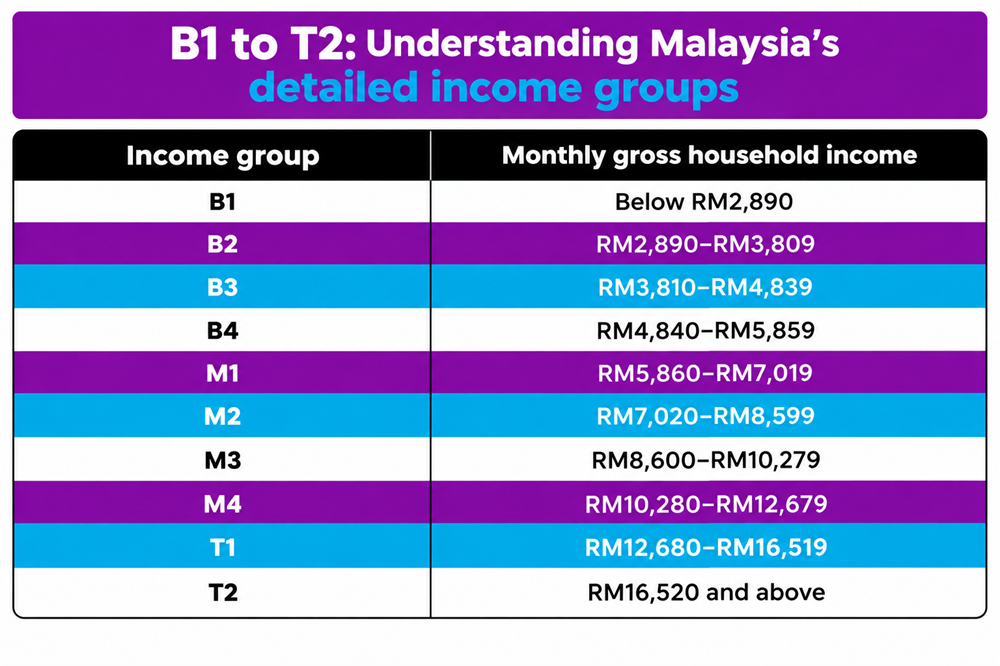
B40, M40 and T20 are Malaysia’s household income groups, representing the bottom 40%, middle 40% and top 20% of households by income. Based on the Department of Statistics Malaysia’s (DOSM) 2024 Household Income Survey, B40 households earn below RM5,860 per month, M40 households earn RM5,860 to RM12,679, and T20 households earn RM12,680 or more.
These classifications are based on total household income, not an individual’s salary. For example, if you earn RM4,000 and your spouse earns RM3,000 monthly, your combined household income is RM7,000, placing your household within the national M40 range, assuming there are no other income sources. Understanding these categories can help you interpret income statistics, check government assistance criteria and assess your household’s financial position more accurately.
B40, M40 and T20 income ranges in Malaysia
According to DOSM’s Household Income Survey Report 2024, the national gross monthly household income thresholds are as follows.
| Income group | Meaning | Monthly household income |
|---|---|---|
| B40 | Bottom 40% | Below RM5,860 |
| M40 | Middle 40% | RM5,860–RM12,679 |
| T20 | Top 20% | RM12,680 and above |
Source: Department of Statistics Malaysia (DOSM), Household Income Survey Report 2024, released on 8 October 2025. These are the latest available national gross household income thresholds as of November 2026. The figures refer to combined household income, not individual salaries.
These classifications show where households fall within Malaysia’s income distribution. They don’t necessarily indicate how much money a household has left after paying for housing, groceries, transport and other commitments.
What does B40 mean?
B40 stands for Bottom 40%, referring to the 40% of Malaysian households with the lowest incomes in the national distribution. Under the 2024 survey thresholds, households earning less than RM5,860 in gross monthly income fall within this category. For example, a household with two working adults earning RM2,500 and RM2,000 respectively has a combined monthly income of RM4,500, placing it in the national B40 group, assuming no other income sources.
Being classified as B40 does not automatically guarantee eligibility for every government assistance programme. Individual schemes may have additional requirements.
What does M40 mean?
M40 stands for Middle 40%, representing households in the middle of Malaysia’s income distribution. Based on the 2024 figures, the national M40 income range is RM5,860 to RM12,679 per month. For example, a household with combined gross monthly income of RM9,000 falls within the national M40 category.
However, two households earning the same amount may have different financial circumstances. A household supporting children and elderly parents may have higher expenses than a smaller household with the same income.
What does T20 mean?
T20 stands for Top 20%, referring to households with the highest incomes in Malaysia’s national household income distribution. Based on the 2024 survey, the national T20 threshold starts at RM12,680 per month. For example, if two working adults earn RM7,000 each, their combined gross monthly household income of RM14,000 places them within the national T20 group. However, being classified as T20 doesn’t necessarily mean a household has substantial savings or disposable income.
Financial commitments, dependants and living expenses can affect how much money remains after monthly expenses.
How to calculate your B40, M40 or T20 income group
To identify your national household income group, calculate your household’s combined gross monthly income and compare it with the published DOSM thresholds. Gross income refers to income before deductions such as income tax and Employees Provident Fund (EPF) contributions. DOSM’s household income definition includes more than salaries. It can also include income from self-employment, property, investments and relevant transfers received.
Step 1. Identify your household members
A household generally consists of people living together and sharing common living arrangements or expenses. This could include a married couple, parents and children, or unrelated individuals who share accommodation and household expenses. However, people living at the same address don’t necessarily form one household if they maintain separate living and financial arrangements.
Step 2. Calculate your combined gross monthly income
Consider this simplified example.
| Household member | Gross monthly income |
|---|---|
| Working adult 1 | RM4,500 |
| Working adult 2 | RM3,000 |
| Combined household income | RM7,500 |
With a combined monthly income of RM7,500, this household falls within the national M40 range. This example assumes both adults belong to the same household and excludes other income sources for simplicity. If your household receives income from a business, rental property or other sources, include the relevant amounts when calculating gross household income.
Step 3. Compare your income with the national thresholds
Once you’ve calculated your household’s gross monthly income, compare it with the B40, M40 and T20 ranges. Remember that the classification uses household income rather than take-home pay. If your household income changes because of a new job, business earnings or changes in household composition, your position relative to the published thresholds may also change.
Why B40, M40 and T20 income thresholds differ by state
Malaysia’s national income thresholds provide a broad comparison, but household income levels vary considerably between states. DOSM also publishes state-specific income thresholds to show how households are distributed within each state’s income levels. For example, the national T20 threshold starts at RM12,680, while the threshold for the top 20% of households in Kuala Lumpur is higher.
The following figures are based on DOSM’s 2024 state-level household income distribution.
| State or federal territory | B40 monthly income | M40 monthly income | T20 starts from |
|---|---|---|---|
| Malaysia, national | Below RM5,860 | RM5,860–RM12,679 | RM12,680 |
| Kuala Lumpur | Below RM9,630 | RM9,630–RM17,029 | RM17,030 |
| Selangor | Below RM9,570 | RM9,570–RM16,039 | RM16,040 |
| Johor | Below RM6,570 | RM6,570–RM13,559 | RM13,560 |
| Penang | Below RM6,370 | RM6,370–RM12,679 | RM12,680 |
| Sabah | Below RM4,120 | RM4,120–RM9,159 | RM9,160 |
| Sarawak | Below RM4,670 | RM4,670–RM9,709 | RM9,710 |
| Kelantan | Below RM3,520 | RM3,520–RM6,999 | RM7,000 |
Source: DOSM Household Income Survey Report 2024, state-level household income thresholds.
Why the same income can fall into different groups
Consider a household earning RM10,000 per month. At the national level, it falls within the M40 category. In Kuala Lumpur, RM10,000 is also within the local M40 range, although it is much closer to the lower threshold. In Kelantan, however, RM10,000 is above the state’s T20 threshold.
This doesn’t mean the household automatically enjoys a better standard of living in one state than another. The categories describe relative income positions within the relevant population. Housing costs, household size and other expenses still matter when assessing affordability.
B40, M40 and T20 compared with Malaysia’s median income
Malaysia’s median monthly household income reached RM7,017 in 2024, according to DOSM. The mean, or average, household income was RM9,155. These figures measure different things.
The median represents the middle household when all households are arranged by income. The mean is calculated by dividing total household income by the number of households. Because higher-income households can pull the average upwards, the mean is often higher than the median.
In Malaysia’s 2024 survey, both figures fall within the national M40 income range. This helps explain why comparing your household income with the national average alone doesn’t tell you which income group you belong to.
Does being B40, M40 or T20 affect government assistance?
Income groups are often mentioned when discussing subsidies, financial assistance and public policy. However, being classified as B40, M40 or T20 does not automatically determine eligibility for every government benefit. Different programmes may consider household income alongside factors such as age, marital status, dependants, residency and other eligibility requirements.
Some schemes also use their own income thresholds or administrative records rather than applying the national B40, M40 and T20 categories directly. For example, a household within the national B40 range may still need to satisfy additional conditions before receiving assistance. Similarly, an M40 household should not assume it is automatically excluded from every government support programme. The most reliable approach is to check the official eligibility requirements for the specific assistance scheme.
What is T15 and how is it different from T20?
T15 refers to the top 15% of households by income, while T20 represents the top 20%. The T15 group is therefore a smaller segment within the broader T20 category.
Although T15 has appeared in discussions about targeted subsidies and income-based policies, it should not be treated as a direct replacement for the established B40, M40 and T20 statistical categories. A single universal T15 income threshold should not be assumed when checking eligibility for government programmes. Instead, refer to the income criteria published for the specific programme, as these may differ from DOSM’s statistical classifications.
How to manage your money regardless of your income group
Knowing whether your household falls within B40, M40 or T20 helps you understand your position in Malaysia’s income distribution. However, your actual financial situation depends on how much money remains after essential expenses, debt repayments and other commitments.
Understand where your monthly income goes
Start by reviewing your household’s take-home income and regular expenses. For example, if your household receives RM6,000 after deductions and spends RM4,800 on housing, groceries, transport, bills and other commitments, you have RM1,200 remaining. That doesn’t mean the entire amount should go into savings. You may still need to account for irregular expenses such as car maintenance, school supplies or annual insurance payments. If you’re looking for practical ways to manage everyday spending, our guide on how to save money in Malaysia explains how small changes to regular expenses can make saving more manageable.
Set money aside for specific goals
Keeping money for future expenses separate from your everyday spending balance can make it easier to track your progress. For example, if you want to set aside RM1,200 over 12 months, you could aim for RM100 each month, provided that amount fits your budget. SAVE in TNG eWallet allows eligible users to set money aside separately from their everyday eWallet balance, starting from RM10. It offers monthly and lump-sum cash-in options.
Money placed in SAVE is invested in the Principal Islamic Money Market Fund. Projected returns are subject to change and are not guaranteed. Review the product’s risks, withdrawal arrangements and terms before using it.
Explore investing when your budget allows
You don’t necessarily need a large amount of money to begin learning about investments. However, before investing, make sure you understand the product’s risks and have enough money available for essential expenses. Our guide on how to start investing with RM10 explains beginner-friendly investment options and what to consider before getting started.
For eligible users, GO+ in TNG eWallet provides access to Principal e-Cash, a Shariah-compliant money market fund managed by Principal Asset Management Berhad. GO+ allows users to start from RM10 and offers potential daily returns with flexible access to their investment balance. However, GO+ is an investment product, not a savings or deposit account. Returns are not guaranteed, and the investment is not protected by Perbadanan Insurans Deposit Malaysia (PIDM).
Whether you’re in the B40, M40 or T20 category, choose financial products based on your needs, available budget and ability to take investment risks rather than your income classification alone.
Understanding your income group is only the starting point
B40, M40 and T20 describe where Malaysian households fall within the national income distribution. The figures are useful for understanding income statistics, but they don’t fully reflect household expenses, financial responsibilities or eligibility for government assistance. Once you know your household’s income group, focus on what you can control such as tracking expenses, managing financial commitments and setting realistic savings goals. You can also explore financial planning resources and investment options through GOfinance in TNG eWallet, while considering your individual financial needs and the risks of each product.
FAQs
What is the B40 income range in Malaysia?
Based on DOSM’s 2024 Household Income Survey, the national B40 category covers households earning below RM5,860 in gross monthly income.
What is the M40 salary range in Malaysia?
The national M40 range is RM5,860 to RM12,679 in gross monthly household income. This is a household income range, not an individual salary bracket.
How much income is considered T20 in Malaysia?
The national T20 threshold starts at RM12,680 in gross monthly household income, based on the 2024 survey. State-specific thresholds may differ.
Is RM5,000 a month considered B40 or M40?
If RM5,000 is your household’s total gross monthly income, it falls within the national B40 range. If RM5,000 is only your individual salary, you need to consider the income of other members of your household before determining its classification.
Is RM10,000 household income considered M40?
Yes. Under the national 2024 thresholds, a household earning RM10,000 per month falls within M40. However, its relative income classification may differ when compared with households within a particular state.
What is the difference between T15 and T20?
T20 represents the highest-income 20% of households, while T15 refers to the top 15%. T15 is a subset of T20, but there is no single universal T15 threshold that should be assumed for all government assistance programmes.