Oct 21 2026
Overnight Policy Rate (OPR): how it affects your loan
by Venus Low

Applying for a loan in Malaysia can feel confusing when each offer comes with terms and factors such as interest rate, repayment period, Standardised Base Rate and Overnight Policy Rate to consider. Understanding how these are connected can help you compare the interest rates, monthly repayments and overall borrowing costs of different loans offers more confidently.
What is the Overnight Policy Rate in Malaysia?
The Overnight Policy Rate (OPR) is Bank Negara Malaysia’s policy interest rate. It guides the rate banks charge when lending money to one another overnight and influences the rates they offer customers. For loan applicants, an OPR change can affect the rate offered on a new floating-rate loan. A higher rate can mean a higher monthly repayment, while a lower rate can reduce it.
The OPR is not your actual loan rate, and not every loan changes when it moves. Before applying, check whether the loan has a fixed or floating rate and whether your budget could manage a higher repayment.
Who sets the OPR in Malaysia?
Bank Negara Malaysia’s Monetary Policy Committee decides whether to raise, lower or maintain the OPR. Its responsibility is to maintain price stability while giving due regard to developments in the economy. The committee reviews domestic and global conditions, including inflation, economic activity, and risks to growth. It does not change OPR according to one indicator alone.
A higher OPR can help moderate spending and price pressures by making financing conditions tighter. A lower OPR can support demand when economic conditions weaken. These effects take time and are not guaranteed to be equal across every household or business.
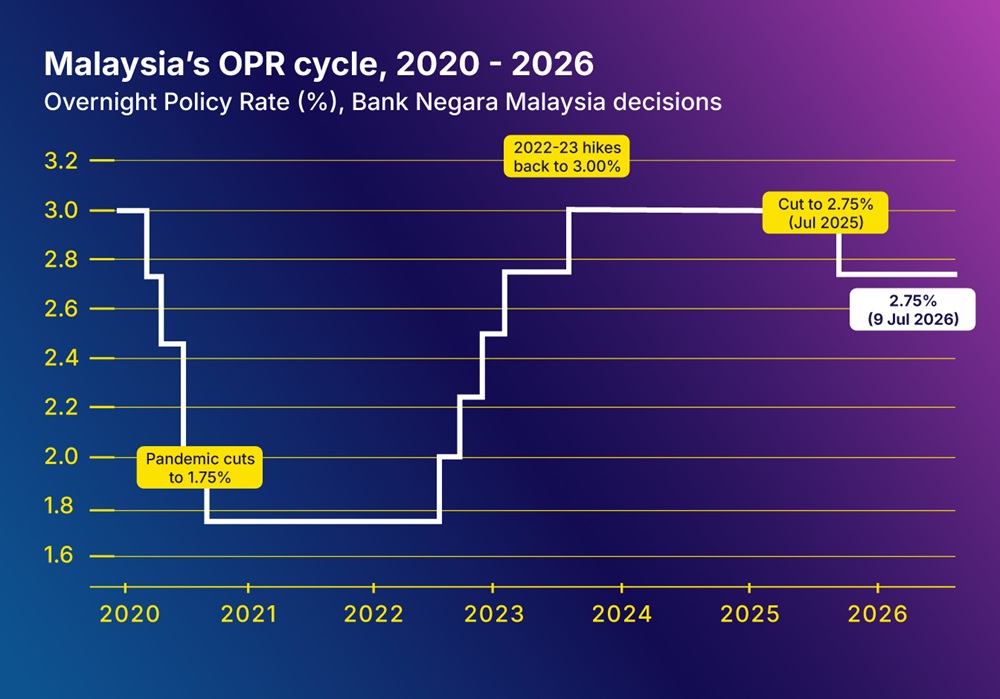
Current OPR in Malaysia
As at 21 October 2026, Malaysia’s OPR is 2.75%. Bank Negara Malaysia’s Monetary Policy Committee maintained this rate on 3 September 2026. The last change was on 9 July 2025, when the OPR was reduced from 3.00% to 2.75%. This was a reduction of 25 basis points, or 0.25 percentage point. The next scheduled decision is on 5 November 2026. Check Bank Negara Malaysia’s latest OPR announcement for any subsequent change.
How OPR affects loan rates
For new floating-rate retail loans and financing in Malaysia, the Standardised Base Rate, or SBR, is the common reference rate used by financial institutions. The SBR is equal to the prevailing OPR and changes by the same amount when the OPR moves. Financial institutions then add an agreed spread to the SBR. This spread may reflect factors such as the borrower’s credit risk, the institution’s operating costs and its profit margin.
For example, if the SBR is 2.75% and the agreed spread is 1.25%, the effective lending or profit rate would be 4.00%. If the OPR and SBR increased by 0.25 percentage points, the effective rate would rise to 4.25%, assuming the spread remained unchanged.
A higher effective rate may increase the monthly repayment for a floating-rate loan. A lower rate may reduce it. The actual change depends on the outstanding balance, remaining tenure, calculation method and terms of the loan agreement. Existing fixed-rate loans do not normally change when the OPR moves. Older floating-rate loans may also use the Base Rate, Base Lending Rate or Base Financing Rate instead of the SBR, so check your agreement to see which reference rate applies.

What an OPR increase or decrease means for borrowers
| When OPR rises | When OPR falls |
| Floating borrowing costs may increase | Floating borrowing costs may decrease |
| Banks may offer higher rates on some new deposits | Banks may reduce rates on some new deposits |
| Existing fixed-rate bonds may face price pressure as market yields rise | Existing fixed-rate bond prices may benefit as market yields fall |
| Spending and credit demand may slow | Spending and credit demand may receive support |
These are general effects, not promises. Banks may adjust product rates at different times, and bonds, equities and the ringgit respond to many factors beyond OPR.
How does OPR affect home loans and other borrowings?
Floating-rate home loans
The Standardised Base Rate, or SBR, is linked directly to the OPR. A retail floating-rate loan may be priced as SBR plus a bank-specific spread. When OPR changes, banks adjust SBR by the same amount under Bank Negara Malaysia’s reference-rate framework. Older floating-rate facilities may still use the Base Rate, Base Lending Rate or Base Financing Rate. Check your agreement and bank notice to understand which benchmark applies, when the revision takes effect and whether your instalment, tenure or both may change.
Here is a simplified illustration for a new RM500,000 fully amortising loan over 30 years.
| Assumed annual rate | Estimated monthly installment |
| 4.00% | RM2,387.08 |
| 4.25% | RM2,459.70 |
| Estimated increase | RM72.62 a month |
This calculation assumes the rate remains unchanged for all 360 payments and excludes fees, insurance and rounding differences. It is not a bank quotation. For an existing loan, use your actual outstanding balance, remaining tenure and contractual repricing method.
Fixed-rate loans and credit cards
A genuinely fixed-rate facility does not automatically reprice when OPR changes during its fixed period. Credit-card finance charges also follow the issuer’s disclosed terms rather than resetting mechanically with every OPR decision. Hire-purchase agreements can have fixed or variable pricing. Read the agreement and compare the effective interest rate rather than assuming every car loan will move with OPR.
How does OPR affect savings and fixed deposits?
Banks may adjust savings-account and fixed-deposit rates when OPR changes, but not necessarily immediately or by the same amount. Pricing also reflects each bank’s funding needs, competition and product conditions. An existing fixed-deposit placement normally keeps its contracted rate until maturity. The rate available when you renew may be different. Compare the effective return, tenure, early-withdrawal conditions and eligibility rather than choosing a promotional rate from the headline alone.
Eligible bank deposits are protected by PIDM up to RM250,000 per depositor per member bank, with separate limits for conventional and Islamic deposits. Unit trusts and money-market funds are not PIDM-protected deposits.
Beyond bank deposits, GO+ and SAVE in TNG eWallet provide access to Islamic money-market funds managed by Principal Asset Management Berhad. Both let you start investing from RM10.
Inflation also matters. If a deposit earns 2.50% while prices rise by 2.00%, its approximate return before tax and after inflation is 0.50%. This simple subtraction does not capture compounding or your personal spending pattern, but it shows why the highest nominal rate is not the only consideration.
What to compare before applying for a loan
Check whether the rate is fixed or floating
A fixed rate may provide more predictable repayments, while a floating rate can move when its reference rate changes. Neither option is automatically better for everyone. Consider how much certainty you need and whether your budget could absorb an increase.
Compare the effective rate
Ask for the effective lending or profit rate and compare offers using the same loan amount and tenure. A low SBR spread does not tell you the complete cost on its own.
Review the repayment and total cost
Check the monthly repayment, number of payments and total repayment over the full tenure. A longer tenure may lower the monthly amount but can increase the total interest or profit paid.
Include fees and settlement terms
Review processing or recurring fees where applicable. Check whether there is a lock-in period, an early-settlement charge or a rebate for settling Islamic financing early.
Test your budget at a higher rate
Work out whether you could still afford the repayment if the effective rate rose by 0.25 or 0.50 percentage points. Include your other monthly debt commitments and essential expenses rather than relying only on the maximum amount a lender may approve.
Your credit history can also affect a lender’s assessment and the terms available to you. Understanding how your credit score affect borrowing can help you prepare before apply.
Use the OPR as one part of your loan decision
OPR sets the broad direction for Malaysia’s financing conditions. Its effect on you depends on the contract, account or investment you hold. Check the latest Bank Negara Malaysia decision, review your own product terms and make changes according to your goals rather than reacting to headlines. If short-term investing fits your plan, open TNG eWallet and review GO+ together with its fund documents and risk disclosures before investing.
FAQs
Does OPR affect housing loans?
Yes. OPR changes can affect variable-rate housing loans, potentially changing your interest rate and monthly repayment. Fixed-rate loans do not automatically change during their fixed-rate period.
What will happen if OPR increases?
Variable-rate borrowing generally becomes more expensive, while banks may offer higher savings and fixed-deposit rates. The effect on your repayments or deposit returns depends on your product’s terms and when the bank adjusts its rates.
Will Bank Negara Malaysia reduce OPR?
A reduction is not certain. The Monetary Policy Committee decides whether to maintain, raise or lower OPR based on inflation, economic growth and the economic outlook.