Nov 27 2026
Cash or card in Japan: what is the best way to pay?
by Venus Low
Planning a holiday to Japan but wondering how much Japanese yen you should exchange before flying? You might have heard that Japan is a cash-based country, but cashless payments have become increasingly common, especially in major cities such as Tokyo, Osaka and Kyoto. The best way to pay in Japan is to carry both cash and a suitable payment card. While international cards are widely accepted at major hotels, shopping centres and convenience stores, cash remains useful at smaller restaurants, traditional attractions and rural destinations. Whether you’re planning a shopping spree in Tokyo, exploring the streets of Kyoto or travelling through the Japanese countryside, here’s what you need to know about using cash or card in Japan, withdrawing Japanese yen and managing your holiday spending.
Is Japan still a cash-based country?
No, Japan is no longer predominantly cash-based, although cash remains an important payment method. According to Japan’s Ministry of Economy, Trade and Industry (METI), the country’s cashless payment ratio reached 58% in 2025 under its domestic measurement framework, with cashless payments totalling ¥162.7 trillion. Credit cards accounted for the largest share of cashless payments, followed by QR and other code-based payments, electronic money and debit cards.
For tourists visiting major cities such as Tokyo, Osaka and Kyoto, cards are widely accepted at hotels, department stores, convenience stores and larger restaurants. However, cash is still useful at smaller independent businesses, traditional markets and rural destinations. While Japan is becoming increasingly cashless, travelling entirely without cash is not advisable. Carrying both Japanese yen and an international payment card remains the most practical approach.
Cash or card in Japan: Which payment method should you use?
The most suitable payment method depends on where you’re going and what you’re buying. Paying for a shopping spree at a department store is different from buying lunch at a small ramen restaurant that uses a cash-only ticket machine. Here’s a general comparison to help you prepare for different payment situations during your Japan holiday.
| Where you’re paying | Cash | International payment card |
|---|---|---|
| Hotels | Generally accepted | Widely accepted |
| Shopping centres and department stores | Generally accepted | Widely accepted |
| Convenience stores | Generally accepted | Widely accepted |
| Small independent restaurants | Often accepted | Acceptance varies |
| Local markets and food stalls | Useful | Acceptance varies |
| Temples and shrines | Useful for smaller payments | Depends on the location |
| Taxis | Generally accepted | Depends on the operator |
| Public transport | Depends on the service | Depends on the operator |
| Vending machines | Generally accepted | Available at selected machines |
| Rural businesses | Important to carry | Acceptance varies |
| Physical Suica card top-ups | Accepted | Credit cards not accepted for top-ups |
Payment acceptance varies by merchant, transport operator and location. Always check the available payment methods before making a purchase.
When should you use cash in Japan?
Even if you prefer cashless payments, there are several situations where having Japanese yen in your wallet can save you from unnecessary inconvenience.
Small restaurants and local food stalls
Part of the fun of travelling to Japan is discovering small ramen shops, independent cafés and local food markets. However, some establishments may not accept international payment cards. Certain restaurants also use ticket vending machines where customers purchase a meal ticket before sitting down. Some of these machines still require cash. If you’re planning to explore smaller neighbourhoods or dine outside major shopping districts, keep some Japanese yen available for meals and snacks.
Temples, shrines and traditional attractions
If you’re visiting historical destinations such as Kyoto or Nara, cash can be useful for entrance fees, small souvenirs and offerings at temples and shrines. Japanese coins and smaller banknotes are particularly handy for these transactions. Don’t assume that every attraction accepts cards simply because it is popular with international tourists.
Rural destinations and smaller towns
Travelling around Tokyo or Osaka may involve fewer cash-only purchases than exploring Japan’s countryside. If your itinerary includes rural accommodation, independent shops or local transport services, check their payment arrangements beforehand. Consider preparing enough cash before leaving major cities rather than relying entirely on finding a compatible ATM at your next destination.
Topping up physical transport cards
Japanese prepaid transport cards such as Suica are convenient for travelling on supported trains and buses. However, according to JR East, physical Suica cards must be topped up using cash rather than credit cards. If you’re planning to use a physical Suica card throughout your holiday, remember to keep some Japanese yen available for top-ups.
When should you use a card in Japan?
International payment cards can be particularly convenient for larger purchases or when you don’t want to carry a substantial amount of cash throughout your holiday.
Shopping for skincare, clothing and souvenirs
International payment cards are widely accepted at larger retailers, including department stores and shopping centres. Whether you’re shopping for Japanese skincare, sneakers, clothing or gifts, using a card means you don’t have to carry enough cash for every purchase. If you’re preparing your shopping list, our guide on what to buy in Japan covers popular Japanese snacks, beauty products, fashion finds and souvenirs worth bringing home.
Paying for hotels and accommodation
Major Japanese hotels generally accept international payment cards. However, if you’re travelling with a prepaid card, check whether your accommodation accepts it for reservations, security deposits and other payment requirements. Payment arrangements can differ between accommodation providers.
Dining at larger restaurants
Restaurants in major shopping centres, international restaurant chains and hotels are generally more likely to accept international payment cards than smaller independent establishments. Look for the relevant payment logos displayed at the entrance or checkout counter before ordering.
Making higher-value purchases
If you’re planning to purchase Japanese watches, electronics, sneakers or premium fashion accessories, carrying enough cash for the entire purchase may be inconvenient. A suitable payment card provides another option, provided the merchant accepts it and your available balance and transaction limits are sufficient. Before completing a purchase, check the applicable exchange rate, fees and final transaction amount.
How much cash should you bring to Japan?
The amount of Japanese yen you should bring depends on your itinerary, travel duration and how frequently you expect to use cash. Rather than exchanging your entire holiday budget, calculate how much you may need for expenses that cannot conveniently be paid by card.
Consider setting aside cash for:
- Meals at smaller restaurants and food stalls.
- Physical Suica card purchases and top-ups.
- Entrance fees and small purchases at traditional attractions.
- Shopping at local markets.
- Visits to rural destinations.
- Unexpected expenses when card payments are unavailable.
Planning your cash budget for a Japan holiday
If you’re spending five days in Tokyo and using your card for accommodation, shopping and larger restaurant bills, your cash requirements may be different from someone spending the same period exploring rural Japan. Before departure, check which parts of your itinerary require cash and estimate the associated expenses. You can then exchange an initial amount of Japanese yen before travelling and withdraw additional cash from supported ATMs in Japan when necessary. There is no universal cash-to-card ratio that suits every traveller. Adjust your payment arrangements according to your actual travel plans.
Should you exchange money before travelling or withdraw cash in Japan?
Both exchanging money before departure and withdrawing cash after arriving in Japan are available options. The more suitable method depends on exchange rates, fees and convenience.
Exchange Japanese yen before departure
Exchanging some money before flying means you’ll have Japanese yen available immediately upon arrival. This can be particularly useful for your first meal, local transport arrangements or purchases at establishments that do not accept cards. For travellers departing from Malaysia, compare the exchange rates offered by authorised money changers before exchanging a large amount of ringgit.
Withdraw Japanese yen from an ATM in Japan
International travellers can withdraw Japanese yen using compatible overseas payment cards at supported ATMs.
Two commonly available options include:
- Seven Bank ATMs: Including those found at 7-Eleven convenience stores.
- Japan Post Bank ATMs: Available at supported post offices and other locations.
Not every Japanese ATM accepts overseas cards, so check whether the machine supports your card’s payment network before attempting a withdrawal. ATM withdrawal limits, exchange rates, operating hours and applicable fees may vary depending on the ATM operator and card issuer.
| Consideration | Exchanging cash before departure | Withdrawing cash in Japan |
|---|---|---|
| Availability | Before travelling | During your holiday |
| Exchange rate | Money changer’s quoted rate | Applicable card conversion arrangements |
| Additional charges | Depends on the provider | ATM operator and card issuer charges may apply |
| Convenience | Cash available immediately upon arrival | Withdraw additional cash when needed |
| Main consideration | Carrying cash throughout your journey | ATM compatibility and withdrawal limits |
Neither method is guaranteed to be cheaper. Compare the exchange rate and applicable charges before deciding.
Should you pay in Japanese yen or your home currency?
When paying by card in Japan, you may occasionally be offered the option to complete your transaction in Japanese yen (JPY) or your home currency, such as Malaysian ringgit (MYR). This is known as Dynamic Currency Conversion (DCC).
What is Dynamic Currency Conversion?
Dynamic Currency Conversion allows merchants or ATM operators to convert overseas transactions into your home currency at the point of payment. Although seeing the amount in your home currency may seem convenient, the conversion rate and charges offered by the merchant or ATM operator may differ from those applied by your card issuer.
Is it better to pay in JPY or MYR?
Choosing Japanese yen (JPY) allows you to decline the merchant’s Dynamic Currency Conversion offer. Your transaction will instead be subject to your card issuer’s applicable currency conversion arrangements. For example, if you’re shopping at a Japanese department store and are asked whether you would like to pay in JPY or MYR, review the displayed exchange rate and applicable charges before confirming your payment. Choosing JPY is a practical way to avoid the merchant’s currency conversion offer, although it does not guarantee that every transaction will be cheaper.
Using the TNG eWallet Visa Travel Card in Japan
Imagine spending the afternoon shopping in Shibuya, stopping for dinner and realising that you don’t have enough Japanese yen left for your next purchase. Having a payment card alongside your cash gives you another way to pay at supported merchants without having to find a money changer immediately.
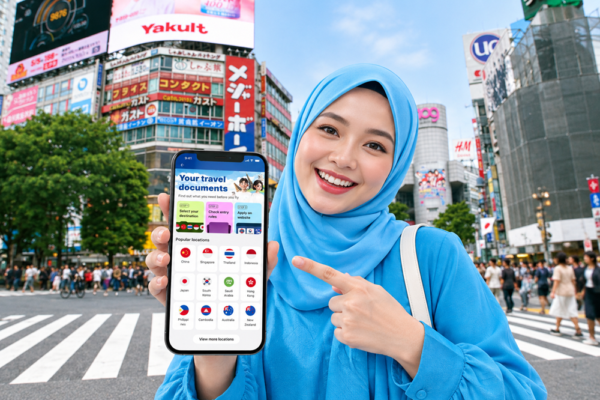
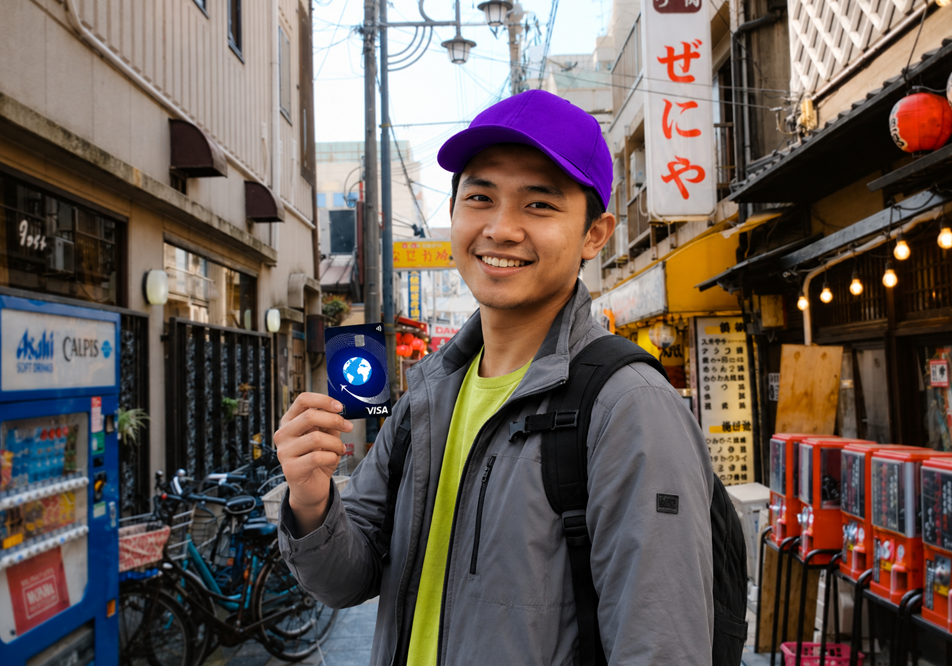
For travellers from Malaysia, the TNG eWallet Visa Travel Card is a prepaid Visa card linked to your TNG eWallet balance. It can be used for eligible payments at Visa-accepting merchants, including those in Japan.
Key features of the TNG eWallet Visa Travel Card
- Worldwide acceptance at Visa-accepting merchants, subject to applicable terms.
- Cash withdrawals at supported Visa Plus-enabled ATMs.
- Access to card transaction history through TNG eWallet.
- Ability to lock or unlock your card through the app.
- In-app spending limit and transaction controls.
- Numberless physical card design, with card details accessible through the app.
Before travelling, visit the official TNG Digital website to review the latest card benefits, fees, currency conversion arrangements, eligibility requirements and transaction limits.
Keep track of your shopping expenses
It’s easy to lose track of your holiday spending when prices are displayed in thousands of yen. Since the TNG eWallet Visa Travel Card is linked to your eWallet balance, you can monitor your available funds and review your card transactions through TNG eWallet. For example, if you’ve allocated a separate budget for Japanese skincare, clothing and souvenirs, you can keep track of your spending throughout your shopping trip. Make sure you have sufficient eligible balance to cover your purchases and any applicable charges.
Withdraw Japanese yen when you need extra cash
If you run low on Japanese yen during your holiday, the TNG eWallet Visa Travel Card supports cash withdrawals at compatible Visa Plus-enabled ATMs, subject to the applicable product terms. This can be particularly useful before travelling to smaller towns or destinations where cashless payment options may be limited. Check the withdrawal amount, exchange arrangements and applicable charges before confirming your transaction. Additional fees may apply depending on the ATM operator and card terms.
Manage your card security while travelling
If you misplace your physical card while exploring Japan, you can lock it through TNG eWallet to help prevent further card use. You can also manage available card transaction controls through the app. If you suspect an unauthorised transaction or your card has been stolen, contact TNG eWallet through its official support channels promptly.
How to apply for the TNG eWallet Visa Travel Card
If you’re planning an upcoming Japan holiday, you can apply for the TNG eWallet Visa Travel Card before departure, subject to eligibility requirements.
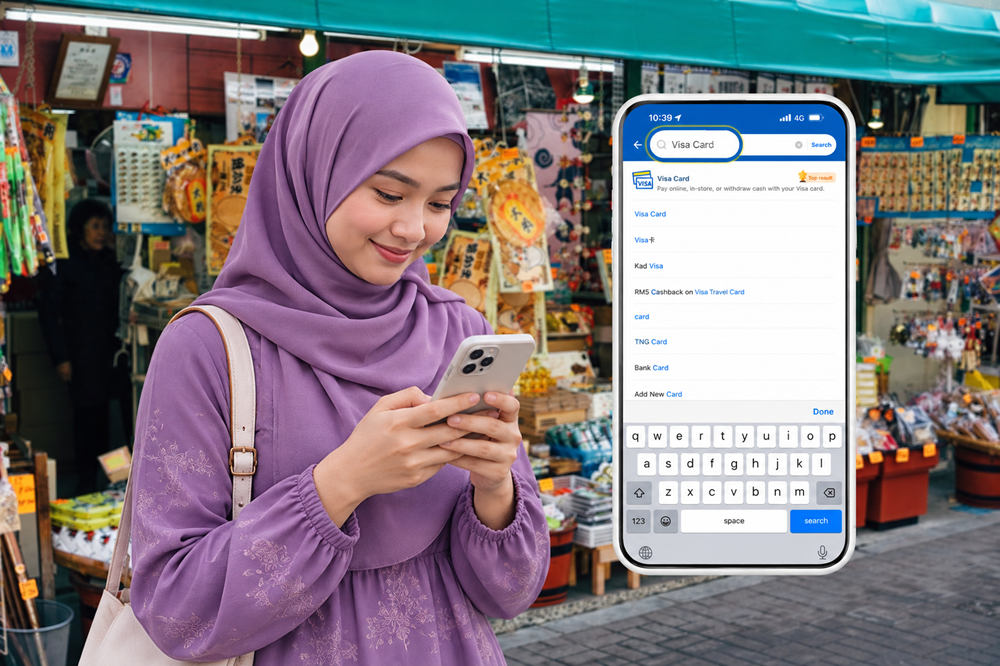
Step 1. Search for Visa Card in TNG eWallet
Open TNG eWallet and type Visa Card into the search bar. Select Visa Card from the search results.
Step 2. Choose the Visa Travel Card
Select the TNG eWallet Visa Travel Card from the available card options. Review its features, eligibility requirements, applicable fees and terms and conditions.
Step 3. Complete your application
Follow the application instructions displayed in TNG eWallet and review the required personal and delivery information.
Step 4. Activate your card
Once your physical card arrives, follow the activation instructions provided through TNG eWallet before using it. Apply sufficiently early to allow time for delivery and activation before your Japan holiday.
Cash, card or Suica: How to pay for public transport in Japan
If you’re visiting Japan for the first time, you might wonder whether your international Visa card can also be used for everyday train and bus journeys. Public transport payment methods vary between operators, so it’s useful to understand the different options.
Use Suica for everyday journeys
Suica is a prepaid Japanese IC card that can be used on compatible trains, subways, buses and monorails. Instead of purchasing a separate paper ticket for every journey, you can tap your Suica card at supported ticket gates, and the applicable fare will be deducted from your balance. Suica can also be used at participating convenience stores, restaurants and other merchants. However, it is not accepted on every transport service or route.
Use international payment cards for supported ticket purchases
International payment cards may be accepted through railway ticket websites, counters and machines that support them. Some Japanese transport operators also offer contactless card payments. However, you should not assume that an international Visa card can be tapped directly at every railway gate in Japan. Check your intended transport operator’s accepted payment methods before travelling.
Keep cash available for Suica top-ups
According to JR East’s official Suica guidance, physical Suica cards can be topped up using cash at supported ticket machines and fare adjustment machines. Credit cards cannot be used to top up these physical Suica cards. This is another reason to carry some Japanese yen even if you intend to use your payment card for most other purchases.
If you’re travelling from Malaysia, our guide on travelling to Japan from Malaysia covers additional considerations to help you prepare for your holiday.
Useful payment tips for travelling in Japan
Prepare for Japan’s new tax refund system
If shopping is a major part of your Japan holiday, there’s an important change to be aware of. Since 1 November 2026, Japan has implemented a refund-based tax-free shopping system. Eligible tourists must pay the full tax-inclusive amount at participating tax-free shops. The consumption tax equivalent is refunded after customs confirmation that the goods are being taken out of Japan, subject to the applicable requirements. The minimum qualifying purchase is generally ¥5,000 before tax per participating store per day. Make sure you have sufficient funds to pay the full purchase amount upfront rather than relying on an immediate tax exemption.
Read our Japan tax refund guide for tourists for more information about the updated requirements and refund process.
Carry smaller Japanese banknotes and coins
Smaller denominations can be useful when making purchases at local shops, vending machines and traditional attractions. Consider carrying a small coin pouch if you expect to make frequent cash purchases during your holiday.
Keep your cash and payment cards separately
Avoid keeping all your cash and payment cards in one wallet. Having an alternative payment method stored separately can be useful if you lose your wallet or encounter a payment issue. It’s also worth checking your available balance and transaction limits before making higher-value purchases.
Stay connected to compare prices and locate ATMs
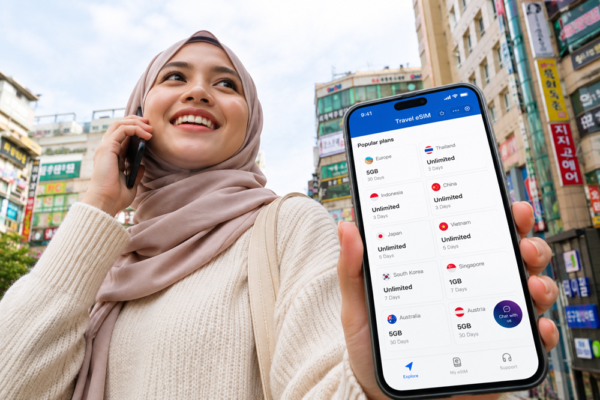
Found a pair of sneakers in Tokyo but aren’t sure whether they’re cheaper back home? Having mobile data allows you to compare prices, check your eWallet balance and locate nearby ATMs while you’re out shopping. Before departure, search for Japan Travel eSIM in TNG eWallet and explore the available Japan data packages. Our best eSIM for Japan comparison explains how to compare data allowances, prices and validity periods based on your travel needs. Check your phone’s eSIM compatibility and the selected package conditions before purchasing.
Cash or card in Japan? Prepare both for your next holiday
You don’t have to choose exclusively between cash and card when travelling to Japan. Cards can be convenient for shopping, accommodation and larger purchases, while Japanese yen remains useful at smaller restaurants, traditional attractions and transport facilities that require cash. For your next Japan holiday, consider preparing some Japanese yen alongside the TNG eWallet Visa Travel Card for eligible overseas payments and cash withdrawals at supported ATMs. Simply open TNG eWallet and search for Visa Card to get started. With your payment arrangements prepared before departure, you can spend more time enjoying Japan’s food, shopping and attractions instead of worrying about how to pay for your next purchase.
Disclaimer: This article is intended for general informational purposes only and does not constitute financial advice. Exchange rates, card fees, transaction limits, eligibility requirements and product benefits may change. Card acceptance and ATM availability depend on the merchant, operator and applicable payment network. Additional charges may apply. Please refer to the latest TNG eWallet Visa Card Terms and Conditions and Product Disclosure Sheet before applying or making transactions.
FAQs
Is it better to use cash or card in Japan?
Using both is generally the most practical approach. International cards are widely accepted at larger businesses, while cash remains useful at smaller establishments, traditional attractions and rural destinations.
Is Japan completely cashless?
No. Although cashless payments are widely available in major cities, some businesses and transport facilities still require cash.
Can I use my Visa card in Japan?
Yes. International Visa cards can be used at Visa-accepting merchants in Japan, subject to card issuer restrictions and applicable transaction conditions.
Can I use the TNG eWallet Visa Travel Card in Japan?
Yes. The TNG eWallet Visa Travel Card can be used for eligible payments at Visa-accepting merchants in Japan, subject to its applicable product terms.